
The Unicafurn Journal

One Year Later: What I’ve Learned from Living with Modular Pieces
  • Article published at:
  • Article author: Unica Furn
  • Article tag: Customer Stories
  • Article comments count: 0
One Year Later: What I’ve Learned from Living with Modular Pieces
When I first clicked "order" on my Unicafurn setup, I’ll admit I was nervous. I loved the look—that sleek, chrome-and-panel aesthetic inspired by mid-century Swiss engineering—but I wondered: Will I actually use the "modular" features? Or will it just stay in one spot forever like every other shelf I’ve owned? One year later, the answer is clear. My furniture hasn't just sat there; it has lived with me. Whether you are looking at the UF Nexus System for your office or your living room, here are the three biggest lessons I’ve learned after 365 days of living with modular design. 1. Furniture Doesn’t Have to be a "Permanent" Decision In the past, moving furniture was a nightmare. You’d measure the wall, buy a shelf, and hope you never moved apartments. Six months into owning my Nexus unit, I decided to turn my "reading nook" into a "home office hub." With a traditional bookshelf, that would have meant buying a new desk. Instead, I spent a Saturday afternoon unbolting my Nexus parts and reconfiguring them. Because I used the UF Nexus Custom Modular Solution, I was able to add a deeper work surface and a drop-down door for my stationery without starting from scratch. The Lesson: Modular furniture is a "living organism." It grows and shrinks based on your life, not your floor plan. 2. Quality is in the "No-Wobble" We’ve all owned that "flat-pack" furniture that starts to lean or creak after six months. I’ve lived with my Nexus unit through a house party, a cat who thinks it’s a jungle gym, and a heavy collection of vinyl records. One year later, there is zero sag. The 304 Stainless Steel tubes are just as bright as the day they arrived, and the joints are still rock-solid. This is where the "Custom" aspect really shines—when a piece is built to your specific needs with high-grade materials, it handles the "load of life" differently than mass-produced alternatives. 3. The "Custom" Advantage is Worth the Wait If you are a "partially demanding" customer like me, you probably have a specific corner or a weirdly shaped wall that standard furniture just won't fit. That’s why I recommend the UF Nexus Custom Modular Solution. This isn't just a "buy now" link; it’s a gateway to a bespoke design. Inspired by the legendary Haller system, this custom service allowed me to specify the exact dimensions for my record player and speakers. One year later, I don't have "dead space" in my room—every inch of that furniture is doing exactly what it was designed to do. My Final Verdict Living with modular pieces has changed my relationship with my home. I no longer feel "locked in" to a layout. If I want to change my vibe next month, I have the parts to do it. If you’re on the fence, start with a custom configuration. Give yourself the freedom to change your mind—your future self will thank you. FAQs: One Year Later Edition 1. Does the 8K mirror polish on the tubes scratch easily? After a year of daily use, I’ve found that the 304 Stainless Steel is incredibly resilient. While micro-scratches are natural over time (just like a high-end watch), they are barely visible and actually add to the "industrial-chic" character of the piece. 2. Is it hard to keep the white panels clean? I chose the "White Collection" for my office. A quick wipe with a microfiber cloth once a month has kept them looking brand new. The powder coating is very dense, so ink or coffee spills haven't stained them at all. 3. How do I start a custom order? You can use the dedicated Custom Modular Solution Link. This link is specifically for those of us who need a tailored fit. The Unicafurn team helps walk you through the measurements to make sure your "one year later" story is as successful as mine.
Learn More
How I Use a Bookshelf as a Bedside Table—and It Works!
  • Article published at:
  • Article author: Unica Furn
  • Article tag: Customer Stories
  • Article comments count: 0
How I Use a Bookshelf as a Bedside Table—and It Works!
The "Standard Nightstand" has a problem. Usually, it’s a small box with one drawer and a tiny surface that immediately gets cluttered with a lamp, a phone charger, and a half-empty glass of water. If you’re a reader, a collector, or someone living in a cozy city apartment, that 20-inch tall box is a wasted opportunity. Meet Sarah, a Unicafurn customer who decided to stop following the "bedroom rules." When she moved into her new studio, she realized her bed took up most of the wall. Instead of squeezing in a tiny nightstand, she used a UnicaFurn UF Nexus Modular Unit originally intended for her books. The result? A "Bedside Library" that transformed her room. Here is why the vertical shift is the best bedroom hack of 2026. The Problem with "Low and Wide" Most bedroom furniture is designed to be low. While this creates a relaxed vibe, it leaves five or six feet of perfectly good wall space completely empty. Sarah found that by using a vertical UF Nexus Modern Bedside Table configuration, she reclaimed that space. "I didn't just want a place for a lamp," Sarah told us. "I wanted a place for my vinyl player, my stack of 'to-be-read' books, and my skincare routine. By stacking my Nexus unit four tiers high, I turned a 15-inch footprint into a massive amount of organized storage." Product Recommendation: The UF Nexus Modern Bedside Table The beauty of the UF Nexus Modern Bedside Table is that it isn't "just" a nightstand. Because it’s built on our signature modular grid, you can customize the height to match your mattress perfectly. The Build: Utilizing our 304 Stainless Steel tubes with an 8K mirror-polished finish, this unit adds a touch of architectural "cool" to the softness of a bed. The Layers: You can keep the top layer open for your morning coffee and a lamp, while using the middle layers for books and the bottom layer—fitted with our Solid Steel Panels—to hide unsightly cables and power strips. The Adaptability: If Sarah moves to a bigger house next year, this "nightstand" can easily grow into a full-sized media console or a kitchen pantry shelving unit. 3 Reasons to "Go Vertical" Beside Your Bed Visual Height: A taller unit next to the bed draws the eye upward, making small bedrooms feel much larger and more like a high-end boutique hotel. The Built-In Library Vibe: There is nothing more comforting than being surrounded by your favorite things. A modular shelf allows you to display art and books right where you spend the most time. Perfect Ergonomics: Traditional nightstands are often too low for modern, thick mattresses. With the Nexus system, you can set the "surface" layer at the exact height of your pillow for easy access. Conclusion: Rules are Meant to be Reconfigured Sarah’s story reminds us that the best homes aren't the ones that follow the catalog—they are the ones that adapt to the person living in them. Whether you call it a bookshelf or a bedside table, the UF Nexus system is whatever you need it to be today. FAQs 1. Is a taller bedside unit stable? Yes. Because the UF Nexus Modern Bedside Table uses a precision-engineered steel frame, it has a much higher stability-to-weight ratio than wooden furniture. For very tall units (over 4 tiers), we always recommend placing heavier items like books on the bottom shelf to create a solid center of gravity. 2. How do I manage lamp cords on an open modular shelf? This is the best part! Our Steel Side Panels can be positioned to hide outlets and cords, or you can use the open architecture of the frame to neatly zip-tie cables along the back of the stainless steel tubes for a "floating" tech look. 3. What if my bed frame is very low? That’s the "Unicafurn Difference." You can simply use shorter tubes for the base layer of your Nexus unit to bring the surface down to floor level. It’s the only bedside table that is truly "bespoke" to your specific bed height.
Learn More
This Stackable System Saved My Marriage (Almost) 😂
  • Article published at:
  • Article author: Unica Furn
  • Article tag: Customer Stories
  • Article comments count: 0
This Stackable System Saved My Marriage (Almost) 😂
They say the true test of any relationship isn't the first vacation or meeting the parents—it’s moving in together and deciding whose furniture stays and whose goes. For my husband and me, the "Great Storage War" started the moment we stepped into our first shared apartment. He’s a "keep everything just in case" person; I’m a "if I haven't seen it in six months, it's gone" person. He wanted a massive, heavy bookshelf that dominated the room; I wanted clean lines and open space. We were headed for a stalemate until we discovered the Unicafurn Nexus system. It turns out, you don't need a marriage counselor; you just need a better grid. Here is how modularity brought peace to our home. The Conflict: His Mess vs. My Aesthetic The entryway was our primary battleground. It was a chaotic pile of his sneakers, my handbags, mail, and umbrellas. We tried three different "off-the-shelf" cabinets, but none of them fit the weirdly shaped nook behind the door. His argument: "We need more drawers for my gym gear!" My argument: "I refuse to have a bulky, ugly wooden box blocking the hallway!" The Solution: We ordered a UF Nexus Multi-Purpose Shoe Cabinet. Because it’s a stackable system, we didn't have to compromise. We built it tall and slim to fit that awkward nook perfectly. The Compromise: The Living Room "Peace Treaty" Next came the living room. He wanted a dedicated space for his sprawling vinyl collection; I wanted a sleek TV stand that didn't look like a bachelor pad. Instead of buying two separate pieces that would clutter the room, we used the UF Nexus to create a single, cohesive "Media Wall." Top Half: Open shelves for his records (he gets easy access, and they actually look like art). Bottom Half: Closed cabinets with our signature steel panels to hide all the messy cables and my "secret" stash of board games. By using the same 304 Stainless Steel frame throughout, the room felt unified. We weren't fighting over space anymore; we were sharing a system. "The beauty of modularity is that it acknowledges that two people can have different needs in the same space. It’s the ultimate design for co-habitation." Why It Actually "Saved" Us (The Practical Stuff) Beyond the aesthetics, the Unicafurn Difference came down to the stress-free experience. No "IKEA Meltdowns": We’ve all been there—screaming over a missing cam-lock. The Nexus system’s precision-engineered brass connectors and simple tool made assembly a collaborative (and dare I say, fun?) Saturday afternoon project. No missing parts, no stripped screws. It Changes When We Do: Last month, we decided to swap the home office and the guest room. In any other scenario, that would mean buying new furniture. With Nexus, we just unstacked a few bays, moved them, and reconfigured them into a new desk setup. Built for the Long Haul: The solid steel construction means this isn't "temporary" furniture. It feels like a permanent part of our home’s architecture, providing a sense of stability that flimsy flat-packs never could. Conclusion: Small Tiles, Big Harmony We still argue about whose turn it is to do the dishes, but we no longer argue about where things go. The UF Nexus system gave us something rare in a shared apartment: a way to be ourselves without stepping on each other's toes. If you're moving in with a partner, don't buy a sofa first. Buy a modular system. It’s the best "relationship insurance" you can get. FAQs 1. Is it really that much easier to assemble than other flat-pack brands? Absolutely. Most "relationship-testing" furniture fails because of confusing instructions and hundreds of tiny, identical-looking screws. The UF Nexus system is different. It’s based on a repetitive, logical grid. Once you understand how one connector works, you understand the whole system. No more "IKEA meltdowns"—just a satisfying, collaborative building experience. 2. My partner has heavy equipment (vinyl, speakers) and I have delicate decor. Can one unit handle both? Yes! That is the strength of the UF Nexus 304 Stainless Steel frame. Unlike particle board that bows under weight, our steel tubes and cold-rolled steel panels are engineered for high load-bearing capacity. You can place a heavy turntable on the bottom bay and your favorite fragile ceramics on the top without any worry about structural integrity. 3. What if we move to a bigger (or smaller) place together? That’s the "marriage-saving" secret. Traditional furniture is a fixed size—if it doesn't fit the new house, you have to sell it and argue about what to buy next. With Unicafurn, you simply buy more tubes and panels to go bigger, or split your one large unit into two smaller ones. It’s furniture that scales with your relationship milestones. 4. How do the magnetic panels help with organization? Since our panels are made of high-quality steel, they are naturally magnetic. This is a game-changer for couples! You can use magnets to attach grocery lists, "to-do" notes, or even photos of your favorite memories directly to the side of the unit. It turns your storage into a functional communication hub for the household.
Learn More
From Dorm to Downtown Loft: My Modular Companion Story
  • Article published at:
  • Article author: Unica Furn
  • Article tag: Customer Stories
  • Article comments count: 0
From Dorm to Downtown Loft: My Modular Companion Story
When I packed for my freshman year of college, my prized possession wasn't a poster or a gaming console; it was a set of boxes from Unicafurn. My parents, both architects, had gifted me a starter set of the UF Nexus modular system. "Buy it once, buy it right," my mom had said. "This will be the last shelving unit you ever need." I didn’t fully grasp what that meant at the time. To me, it was just a cool, industrial-looking shelf for my textbooks and instant noodles. Looking back, almost a decade later, as I sit in my downtown loft, that same modular system—now twice as big and in a completely new configuration—is the anchor of my living room. It’s the only object that has been with me on my entire journey. It’s not just furniture; it’s my companion. This is our story. Act I: The Dorm Room (The Ultimate Space-Saver) My freshman dorm room was a 10x12 concrete box. Space wasn't just limited; it was non-existent. My initial set was a simple, two-bay wide, three-bay high configuration. It became my everything. The bottom cubes, with doors, became my pantry and shoe storage. The middle shelves were my library for heavy textbooks. The top, open shelf was my entertainment center, holding a small TV. I even used one of the panels as a makeshift vertical desk. It was a compact, all-in-one survival unit. While my roommates were stacking plastic crates, I had a piece of genuine, architectural furniture that instantly made my side of the room feel organized, intentional, and grown-up. Its durability was also immediately put to the test—it shrugged off spills, bumps, and the general chaos of dorm life without a single scratch. Act II: The First Apartment (The "Divide and Conquer" Era) After graduation, I moved into my first "real" apartment with two roommates. The challenge was different. We had a large, awkward living room and zero privacy. This is where my Nexus system truly showed its genius for the first time. I bought a few extra components and "split" my original unit. The Vertical Tower: I reconfigured the first half into a tall, skinny, five-bay-high tower that became my home office—a sleek, vertical workstation in a tiny corner of my bedroom. The Room Divider: The second half was built into a long, three-bay-high open shelf. We used it as a "soft wall" to divide our living room from the dining area. It defined the space, gave us much-needed storage, and looked incredible—a true piece of . It was the first time I realized my mom was right. I didn't need new furniture; I just needed a new idea. Act III: The Downtown Loft (The "Final Form" Statement) Today, I live in a downtown loft with high ceilings and wide-open spaces. My life, and my needs, have evolved again. And so has my Nexus. I recombined all my components from the past eight years and invested in several new ones to create my "final form" setup: a massive, wall-to-wall, five-bay wide media and library unit. It anchors the entire living room, with a mix of closed cabinets for my electronics, drawers for my files, and dozens of open shelves for my book and art collection. The is perfectly integrated into the center. The 8K polished 304 stainless steel frame, which has been assembled and reassembled at least four times, still looks brand new and gleams in the afternoon light. It's the same system I had in my dorm, yet it’s a completely different, infinitely more sophisticated piece of furniture. It has grown with me. Conclusion: An Investment in a Life Not Yet Lived When my parents gave me that first set, they weren't just giving me shelves. They were giving me a long-term, sustainable solution. They were investing in a life I hadn't even lived yet. That’s the difference. Fast furniture is for the person you are right now. A modular system is for the person you have yet to become. It’s a quiet, reliable companion, ready to adapt to whatever new chapter comes next. And that’s a story worth investing in.   FAQs   1. Does the Nexus system get weaker or wobbly after being reassembled so many times? Not at all. This is its key strength. Because it’s built with solid 304 stainless steel and precision-engineered brass connectors, the system is designed for a lifetime of reassembly. The connections remain just as rock-solid and stable as they were on day one. 2. Is it easy to get new parts to expand an old system? Yes. Unicafurn is committed to the long-term viability of the Nexus system. You can order individual components—a single tube, a new panel in a new color, or an extra drawer—at any time, ensuring your system can always grow and adapt. 3. Is a high-end system like this worth it for a college student? If you view it as a 10-year investment instead of a 1-year solution, it’s one of the most economical decisions you can make. You’re buying one piece of furniture that will serve as a dorm shelf, an apartment room divider, and a professional home office library, saving you the cost and waste of buying and discarding 3-4 cheaper pieces along the way.
Learn More
What I Wish I Knew Before Buying My First Bedroom Set
  • Article published at:
  • Article author: Unica Furn
  • Article tag: Customer Stories
  • Article comments count: 0
What I Wish I Knew Before Buying My First Bedroom Set
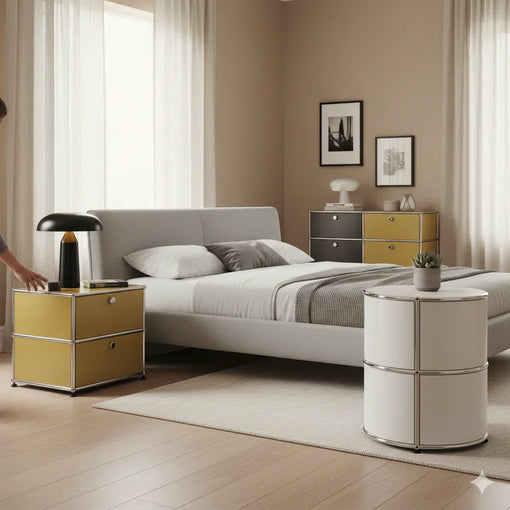
I remember the feeling vividly. Standing in a massive furniture showroom, I had just signed the lease on my first “real” apartment. The allure of the matching bedroom set was irresistible. A big, important-looking bed frame, two identical, chunky nightstands, and a dresser so large it felt like a declaration of adulthood. It promised a shortcut to a perfectly coordinated, grown-up room. I bought it all. And for the first few weeks, it felt great. Then, reality set in. That purchase, which felt so right at the moment, became a masterclass in all the things I wish I knew back then. It took me years to undo that one-size-fits-all mistake and build a bedroom that truly worked for my life. If you're about to furnish your first bedroom, here are the lessons I learned the hard way. The Big Mistake: Believing "Matching" Means "Designed" My first mistake was equating a matching set with a well-designed space. The reality was the opposite. The massive dresser took up a third of the room but was always half-empty, a monument to wasted space. The two identical nightstands were a source of constant, low-grade frustration. I’m a reader who needs a shelf for books; my partner needs drawers for gadgets and chargers. We had identical furniture for our completely different lives. The room wasn’t designed; it was just duplicated. It lacked personality, and more importantly, it lacked real-world functionality. The Upgrade: The Three Lessons That Changed My Bedroom After a few years, we decided to break up with the bedroom set and start over, piece by piece, with a new philosophy: choose furniture that fits your life, not just the room. This led us to Unicafurn, a brand that seemed to understand this philosophy of intentional, high-quality design. Here’s what we did differently. Lesson 1: Your Nightstands Should Be Partners, Not Twins. This was our most transformative upgrade. We realized our bedside needs were completely different, so we chose two pieces that, while not identical, felt like they were in a stylish conversation. For My Side (The Reader): I chose the UF Nexus Modern Bedside. It's a single, two-level modular cube. The architectural, clean lines felt calm and sophisticated. I opted for an open top shelf for my current book and a closed cabinet below to hide clutter. The open-back design is genius for discreetly managing my phone charger. For My Partner's Side (The Organizer): He chose the UF Open Me Anytime Storage Container. Inspired by the classic Componibili, its playful, round shape is a beautiful contrast to the sharp lines of the Nexus. Its three stacked compartments with sliding doors are perfect for organizing the mess of cables, notebooks, and small items he uses daily. The result? Two pieces that are perfectly tailored to our individual needs, yet harmonized through a shared commitment to great design. Lesson 2: A Dresser Isn't Always the Answer. We ditched the huge dresser. Instead, we analyzed our actual storage needs. We realized we needed more flexible storage for smaller items. We replaced the dresser with a low, three-bay wide modular Nexus unit that now serves as a stylish bench at the foot of our bed, with a mix of drawers and closed cabinets for targeted storage. It opened up the room and felt infinitely more intentional. Lesson 3: Quality and Personality Trump Forced Cohesion. Our old set was a sea of cheap, matching wood veneer. Our new bedroom is a mix of high-quality, authentic materials. The 8K polished steel of the Nexus nightstand, the smooth ABS resin of the storage container, the warmth of a new solid wood bed frame—it all feels so much more real and personal. This collection of thoughtfully chosen bedroom furniture tells a story. It’s a reflection of who we are and how we actually live. It feels curated, not purchased off a showroom floor. Conclusion: Buy for the Life You Have My biggest takeaway is this: don't let a pre-packaged set dictate how you should live in your own space. A bedroom is the most personal room in your home; its furniture should be just as personal. Take the time to analyze your own habits. Invest in individual, high-quality pieces that solve your specific problems. Mix, don't match. The result will be a space that not only looks better but feels fundamentally, authentically yours.   FAQs   1. Is it okay for my nightstands not to match? Absolutely! It's a hallmark of a modern, well-designed space. The key to making it work is to create cohesion in other ways. For example, the nightstands could be the same height or color, or they could share a common material (like a metal finish) with other elements in the room. 2. What should I look for in a good nightstand? Look for three things: the right height (it should be roughly level with the top of your mattress), the right function (drawers for clutter, shelves for books, etc.), and high-quality materials that feel good to interact with every day. 3. What's a good alternative to a traditional dresser in a small bedroom? Consider a vertical modular shelving unit with integrated drawers. It uses vertical space, has a smaller footprint, and can be customized to your exact needs. Alternatively, a low, long credenza can double as a TV stand or a display surface, making it more versatile than a traditional dresser.
Learn More
I Moved 3 Times, But My Bedside Storage Container Stayed With Me
  • Article published at:
  • Article author: Unica Furn
  • Article tag: Customer Stories
  • Article comments count: 0
I Moved 3 Times, But My Bedside Storage Container Stayed With Me
My twenties were a decade defined by cardboard boxes. I moved from a college dorm to a tiny studio in the city, then to a slightly bigger one-bedroom with my partner, and finally, to our current place. Each move was a new chapter, but it also created a familiar graveyard of discarded furniture. There was the flimsy particleboard bookshelf that didn't survive the first move, the trendy but wobbly desk that felt wrong in the second apartment, and the cheap nightstands that were simply left behind. It was a constant cycle of buying for the “now” and discarding when the “now” inevitably changed. Through all that upheaval, however, one piece of furniture has been my constant, loyal companion: a small, unassuming, three-tiered storage container. It wasn’t the most expensive or the largest piece I owned, but looking back, it was without a doubt the smartest. It has followed me through three homes, playing a different, vital role in each one. This is its story. Act I: The First Apartment – The Perfect Bedside Companion I bought my UF Open Me Anytime Storage Container right after college. I was drawn to its playful, retro, Space Age vibe—a perfect tribute to Anna Castelli Ferrieri’s iconic Componibili design. For my first tiny studio, it was the perfect nightstand. It was compact enough to fit in the tight space between my bed and the wall, but its three cylindrical compartments held a surprising amount of life. The smooth, sliding doors were a genius touch, allowing me to hide the inevitable clutter of chargers, sleep masks, and half-finished tubes of hand cream. The top surface was the perfect perch for my lamp, my phone, and a glass of water. In a room where every inch mattered, it was a masterclass in efficient, stylish design. Act II: The Second Apartment – The Unsung Bathroom Hero Two years later, I moved into a one-bedroom with my partner. Our new bedroom had a different layout and more space, and we opted for two matching nightstands. Suddenly, my loyal container was homeless. For a moment, I thought its journey with me might be over. Then, as I stood in our new, characterless bathroom that had zero storage, I had an idea. I remembered the container was made from high-grade ABS resin—a durable, waterproof plastic. I gave it a quick wipe-down and moved it into the bathroom. It fit perfectly in the corner next to the sink. It was a revelation. The once-bedside companion became the ultimate bathroom organizer. The top tier held our toothbrushes and daily skincare, the middle held extra toilet paper rolls, and the bottom was for cleaning supplies. Its cheerful white finish brightened up the sterile room, and its easy-to-clean surface was unfazed by moisture. It had seamlessly adapted to a completely new and demanding role. Act III: The Third (and Current) Home – The Living Room Sidekick Our most recent move was into a space we plan to call home for a while. We invested in more “grown-up” designer furniture, and once again, I wondered where my little container would fit in. I shouldn’t have worried. Today, it sits proudly in our living room, right next to our main sofa. It has been promoted to a stylish side table. Its three tiers are perfect for stashing away remotes, coasters, and the magazines we never seem to finish. The top surface is now a chic pedestal for a thriving green plant. It’s no longer just a utility piece; it’s a conversation starter. Friends who appreciate design always comment on its iconic, timeless form. Why This One Piece Survived Looking back, I understand why this small container from Unicafurn outlasted every other piece of furniture from my early twenties. Timeless Design: Its simple, sculptural, and slightly playful form never went out of style. It looked just as good in my chaotic first studio as it does in our more curated living room today. Honest, Durable Materials: High-quality ABS resin is a forgiving and incredibly durable material. It has shrugged off spills, bumps, and years of daily use without a single crack or chip. Inherent Versatility: This is its superpower. Because its design isn't tied to a specific function—it's just a beautiful, simple container—it can be anything you need it to be. A nightstand, a bathroom caddy, a side table, a plant stand, an office organizer... its potential is limited only by your imagination. Conclusion: The Smartest Investment In a decade of constant change, this small storage container has been a reliable, adaptable, and beautiful constant. It’s a testament to a philosophy of buying fewer, better things. It taught me that the best furniture isn’t always the biggest or the most expensive, but the smartest. It’s the piece that can move and evolve with you, becoming a quiet, cherished part of your life’s story.   FAQs   1. What is ABS resin, and why is it a good material for furniture? ABS is a high-grade, non-toxic thermoplastic known for its exceptional durability, impact resistance, and smooth, high-quality finish. It's the same material used in things like car dashboards and LEGO bricks. It’s strong, lightweight, and waterproof, making it incredibly versatile for modern furniture. 2. How much weight can a container like this hold? A well-made ABS storage container is surprisingly strong. The UF Open Me Anytime Storage Container, for example, has a weight capacity of up to 60KG (about 132 lbs), making it more than sturdy enough for books, lamps, plants, and everyday items. 3. Is this type of furniture only for modern or retro interiors? Not at all. While it was born from the Space Age design movement, its simple, geometric form is incredibly versatile. In a more traditional or eclectic room, a white or black version can act as a quiet, minimalist accent piece. In a colorful, bohemian space, a brightly colored version can be a fun, playful pop.
Learn More
My Bedroom, My Rules: How I Designed a Space That Truly Fits Me
  • Article published at:
  • Article author: Unica Furn
  • Article tag: Customer Stories
  • Article comments count: 0
My Bedroom, My Rules: How I Designed a Space That Truly Fits Me
For years, my bedroom felt like it belonged to someone else. It had all the standard parts—a bed, two matching nightstands, a bulky dresser—a generic set I’d bought in a hurry. It was functional, sure, but it wasn’t me. The room was designed around the furniture, instead of the furniture being designed around my life. My life isn’t generic. I’m a night-owl reader with a book collection that’s constantly threatening a hostile takeover. I’m a remote worker who sometimes takes video calls from the quietest corner of my apartment. And I’m a minimalist who despises clutter. The traditional bedroom set, with its rigid forms and wasted space, simply wasn’t working. The bulky dresser was half-empty, yet my books were piled on the floor. I realized I didn’t just want to redecorate; I wanted to reclaim my space. I wanted a bedroom that was a true reflection of my habits, my hobbies, and my rules. This led me to a simple but powerful conclusion: I needed to stop buying furniture and start designing a system. The Discovery: Moving Beyond the Bedroom Set My search for a more intelligent solution led me to the world of modular furniture. It was a complete revelation. The idea that I could choose my own components—open shelves, closed cabinets, drawers, different colors—and combine them to create a custom solution felt like a superpower. I was immediately drawn to the UF Nexus system from Unicafurn. It didn’t look like typical storage; it had the clean lines and high-quality finish of an architectural system. The 8K polished steel and rich panel colors felt sophisticated and intentional. I spent an evening sketching out a plan, not just to store my things, but to create three distinct "zones" within my one small bedroom. The Execution: Building My Multi-Zone Sanctuary Instead of a single, monolithic bedroom set, I used different Nexus configurations to create dedicated areas for sleeping, reading, and getting ready. Here’s how it came together: The Sleep Zone: Calm and Contained My old nightstands were a constant source of frustration. I replaced them with two different, low-profile Nexus cubes. On my side, I built a unit with an open top cube for my current book and a closed cabinet below to hide my laptop and chargers—a built-in digital detox zone. On my partner’s side, a simple, open two-shelf unit holds a water carafe and a few personal items. They don’t match perfectly, but they’re part of the same design family, creating a look that’s cohesive yet perfectly personalized to our individual needs. The Reading Zone: My Personal Library My book pile crisis was solved with a three-bay wide, two-bay high Nexus unit placed against the longest wall. It was low enough not to overwhelm the room, but it provided an incredible amount of storage. I used a mix of open shelves for my favorite novels and two closed cabinets to hide the clutter of magazines and notebooks. The top surface became a beautiful display for plants and a framed print, turning a storage piece into a stylish credenza. The “Get Ready” Zone: A Modern Vanity The bulky dresser was the first thing to go. I realized I didn't need huge drawers for folded sweaters. I replaced it with a slim, vertical Nexus tower. The unit has two small drawers for socks and essentials, and several open shelves above for my perfume bottles and a beautiful ceramic tray for my jewelry. It’s a more elegant, functional, and space-efficient solution that feels like a modern vanity. This collection of bedroom furniture finally felt like it was designed just for me. The Result: A Room That is 100% Mine For the first time, my bedroom feels like a true extension of who I am. Every object has a logical home. The space feels calmer, more organized, and significantly larger, because every piece of furniture is working exactly as hard as it needs to, without any wasted space. The process of designing my own solutions was incredibly empowering. It was a declaration that I don’t have to live with the generic, one-size-fits-all solutions that traditional furniture stores offer. I can create a space that is tailored to my life, my rules. Conclusion: Design Your Space, Design Your Life Your bedroom is your most personal space—it should be the most personalized room in your home. Breaking free from the traditional bedroom set and embracing a modular approach is about more than just organization. It’s about taking control of your environment and creating a sanctuary that truly supports and reflects the life you want to live.   FAQs   1. Is it okay if my partner and I have different nightstands? Absolutely! This is one of the biggest advantages of a modular system. As long as the pieces are from the same design family (like the UF Nexus), having different configurations on each side of the bed can look incredibly stylish and intentional, while perfectly serving each person's individual needs. 2. Can modular furniture be used for clothing storage? Yes. A modular system with a mix of deep drawers, closed cabinets with shelves, and even hanging rails can create a highly efficient and customized wardrobe or dresser, especially for small space bedroom furniture. 3. Does designing your own furniture configuration require special skills? Not at all. The beauty of a system like the UF Nexus is that it's based on simple, intuitive building blocks. You can sketch out your ideas on a piece of paper or use online configurators. It’s a fun and creative process that anyone can do.
Learn More
The Best Modular Decision I Made as a Remote Worker
  • Article published at:
  • Article author: Unica Furn
  • Article tag: Customer Stories
  • Article comments count: 0
The Best Modular Decision I Made as a Remote Worker
For the first year of remote work, my “office” was a chaotic corner of my living room. My dining table was command central, permanently covered in a web of laptop chargers, notebooks, and half-empty coffee mugs. The line between “work life” and “home life” didn’t just blur; it evaporated completely. My productivity suffered, but worse, my ability to truly relax in my own home disappeared. I knew I needed a dedicated workspace, but the thought of squeezing a clunky, traditional desk into my small apartment was depressing. It felt like a surrender—an admission that my living room would forever be just a satellite office. I wanted a solution that was smart, stylish, and respected the fact that my home still needed to feel like a home. That’s when I started looking beyond traditional desks and discovered the world of modular office furniture. It was a complete mindset shift. I wasn’t just looking for a surface to put my laptop on; I was looking for an intelligent system that could create a functional, beautiful workspace that integrated seamlessly into my living area. My search ended when I found the UF Nexus system from Unicafurn. It was the perfect blend of architectural elegance and practical genius. I invested in a simple setup, and I can say with absolute confidence: it was the single best decision I’ve made for my career and my well-being as a remote worker. The Setup: Creating a "Command Center" That Could Disappear I designed a low-profile, two-bay wide unit to place against a wall in my living room. One bay was an open shelf for my monitor, and the other was a cabinet with a door. Above the monitor, I added a single, wide shelf. It was simple, but it was a game-changer. Here's how this modular setup solved my biggest remote work challenges: It Created a Psychological "On/Off" Switch: This was the most profound change. My Nexus unit became a clearly defined “work zone.” When I sat down in the morning, I was at my command center. But at 5 PM, my end-of-day ritual became incredibly satisfying. I’d put my laptop and notebooks inside the closed cabinet, turn off the monitor, and walk away. The unit would transform back into a beautiful, minimalist credenza. This simple act of closing a door allowed my brain to truly disconnect. My living room was my living room again. It Solved the Clutter Crisis (and My Zoom Background): My previous setup was a mess of visible cables, stacked papers, and random office supplies. The Nexus system provided a home for everything. The closed cabinet hides my laptop, keyboard, and planners. The open shelf above my monitor is styled with a few inspiring books and a plant, creating a professional, curated background for all my video calls. My colleagues have even commented on my “beautiful office.” Little do they know it’s a compact, hard-working unit in the corner of my living room. It Was an Investment in Adaptability: I chose a modular system because I know my life isn’t static. Right now, this setup is the perfect home office. But if I move to a new apartment with a dedicated office room next year, I don’t have to sell this piece. I can reconfigure it into a media console, a library shelf, or even split it into two separate bedside tables. A piece like the UF Nexus Storage TV Stand has endless possibilities. It’s a long-term asset, not a temporary fix. More Than a Desk: A Tool for Better Living What I ultimately gained wasn’t just a place to work; it was a better way to live. My productivity during the day has soared because my workspace is organized and free from distraction. And my ability to relax in the evenings has returned because my work can be physically and visually put away. The quality of the system itself contributes to this sense of calm. The solid feel of the steel panels, the quiet click of the soft-close door, the satisfying precision of the components—it all adds up to a feeling of quality and order that has a ripple effect on my entire day. Conclusion: The Smartest Way to Work from Home If you're a remote worker struggling to find the balance between your job and your life in a small space, I can't recommend a modular approach enough. It’s an investment in a system that respects your home, supports your focus, and adapts to your future. It was the best decision I made, and my only regret is that I didn't do it sooner.   FAQs   1. Is a modular system a good replacement for a traditional desk? For many remote workers, it's even better. While a traditional desk offers a large surface, a modular unit offers integrated storage and visual cohesion with your living space. It’s a more holistic solution for a work-life environment. 2. Can I manage all the cables and chargers with a modular unit? Yes. High-quality systems like the UF Nexus are designed with this in mind. The space behind the panels and the open-back design of many configurations make it easy to run and conceal cables, keeping your workspace clean and tidy. 3. Is a modular home office setup easy to expand if my needs grow? That's one of its greatest strengths. If you find you need more storage or a larger worksurface, you can simply purchase additional components—tubes, panels, or drawers—and expand your existing setup. It’s a system designed to grow with your career.
Learn More
We Moved—Our Modular Furniture Moved With Us
  • Article published at:
  • Article author: Unica Furn
  • Article tag: Customer Stories
  • Article comments count: 0
We Moved—Our Modular Furniture Moved With Us
There are few words in the English language that inspire more universal dread than “moving day.” It’s a chaotic ballet of cardboard boxes, packing tape, and the sinking feeling that you own far too much stuff. But the worst part? The furniture. I’m talking about the bulky bookshelf that’s too heavy to lift but too fragile to survive the trip. The particleboard dresser that you know will turn into a pile of sawdust if you even look at its screws the wrong way. And the dreaded sofa-pivot in the narrow hallway. We’ve all been there. For years, I accepted this as a non-negotiable part of modern life. Furniture was a temporary, location-specific purchase. But when my partner and I prepared for our cross-country move last month, we were facing a different reality. Two years ago, we had made our first real “grown-up” furniture investment: a beautiful, architectural shelving system from Unicafurn. We loved it, but now we were faced with a daunting question: could our beloved modular system—our biggest investment—actually survive the move? The answer, as we discovered, was a resounding yes. It didn’t just survive; it thrived. Here’s a practical guide to how our modular furniture not only moved with us but made our new house feel like home from day one. The Disassembly: A Surprise in Precision My past experiences with disassembling furniture involved stripped screws, splintered wood, and a confusing pile of parts I knew would never fit back together quite right. The thought of taking apart our UF Nexus system was nerve-wracking. But the experience was completely different. Armed with the specialized toolkit that came with our system, the process felt less like demolition and more like a satisfying, mindful puzzle. The Components: Every tube, panel, and connector came apart cleanly and smoothly. There was no wrestling or forcing. You could feel the precision engineering in every part. The solid brass connector beads unscrewed without any wear, and the 8K polished stainless steel tubes were incredibly robust. The Packing: Instead of a single, massive piece of furniture, we were left with a neat, compact stack of panels and a box of tubes and connectors. It took up a fraction of the space in the moving truck and was far easier (and safer) to transport. This was our first "aha" moment. High-quality modular furniture isn't just designed to look good; it's designed to be taken apart and put back together, again and again. The Reimagination: New Home, New Configurations The real magic happened when we arrived at our new home. The layout was completely different. The long wall in our old living room that was perfect for our wide media console was gone, replaced by a smaller living area with tall ceilings. With traditional furniture, this would have been a disaster. With our modular system, it was an opportunity. Here’s how we reused every single component of our old setup to create brand-new solutions for our new space: From Media Console to Home Office Hub: Our original 3-bay wide, 2-bay high media unit was no longer a fit. So, we reconfigured it. We used the same components to build a tall, 2-bay wide, 3-bay high vertical shelving unit that fit perfectly into a nook in our new home office. It now holds our printer, books, and files, transforming from an entertainment piece into a productivity powerhouse. From Leftover Parts to a Perfect Entryway Bench: After building the office tower, we still had one column of components left over. Instead of letting them go to waste, we used them to create a low-profile, 1-bay wide, 2-bay high unit. We placed it by our front door, added a felt basket to the bottom cube for shoes, and kept the top surface for keys and mail. It became the perfect piece of small space furniture and an elegant, functional entryway solution that we hadn't even planned on. Lessons Learned: A Guide for Your Move Moving with a modular system was a game-changer. If you're planning a move with yours, here are a few practical tips: Label Everything: As you disassemble, use painter's tape to label bags of connectors for each section. It will make reassembly much faster. Keep Your Toolkit Safe: That specialized toolkit is your best friend. Keep it in a clearly marked box that you pack last and unpack first. Embrace a New Vision: Don't try to force your old layout into your new space. Lay out all your components and think of them as building blocks. Measure your new rooms and sketch out new possibilities before you start building. Conclusion: Furniture for a Life in Motion Our move taught us a valuable lesson. Investing in a high-quality modular system isn't just about buying furniture; it's about investing in a more sustainable, flexible, and stress-free way of living. It’s the only furniture I’ve ever owned that has actually gained value after a move, by adapting to become exactly what our new home needed. It moved with us, and in the process, it helped us feel settled, organized, and truly at home.   FAQs   1. Does taking apart and reassembling modular furniture damage it? A high-quality system is specifically engineered for this. The precision of the connectors and the durability of materials like solid steel in the Unicafurn Nexus system ensure that it can be reconfigured many times without any loss of strength or stability. 2. Is it hard to keep track of all the small parts during a move? The key is organization. Using small, labeled Ziploc bags for the connectors and screws from each section you disassemble makes the process much more manageable and stress-free during reassembly. 3. Is modular furniture really a good investment for renters or people who move often? It's ideal. Compared to heavy, traditional furniture that is difficult to move and may not fit your next space, a modular system is a long-term asset. It packs down efficiently, is less prone to damage during transit, and its adaptability means you won't have to sell it at a loss and buy new furniture for every new home.
Learn More